

In brief
A guest doesn’t judge a restaurant on a single dish. They judge it on a sequence of moments, some of which last only a few seconds.
Seen through an auditor’s eyes, each moment of truth reveals what the guest will never say out loud, but which will decide whether they come back.
The real issue isn’t the price bracket – it’s presence: being there, at the right moment, in the right way.
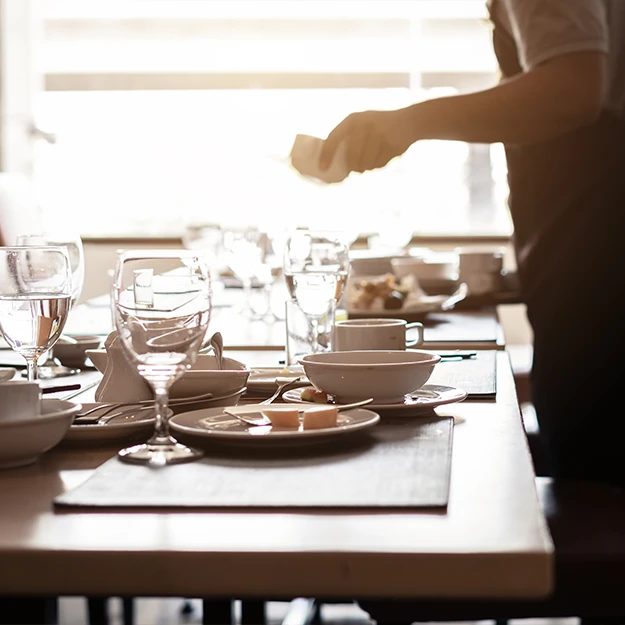
The restaurant trade is a trade of the moment. Where a hotel stay unfolds over several days, a meal plays out in an hour and a half. Every second there carries disproportionate weight.
And yet, most restaurateurs assess their restaurant guest experience through a distorting lens: online reviews. Reviews tell you the overall impression, never the micro-moments. They capture neither the transitions, nor the five minutes spent waiting for the bill, nor the consistency between the dining room and the kitchen.
An auditor’s eye, by contrast, breaks the meal down into restaurant moments of truth. It’s this breakdown that makes action possible, because you can only properly fix what you’ve first named.
The booking: the first moment of truth (and the most overlooked)
Everything starts before the table. The phone rings, and the establishment is already telling its story.
What the auditor assesses here is clinical: the time taken to pick up, the tone of voice, the ability to handle a specific request. An allergy, a birthday, a table away from the passing traffic: every question is a probe.
A phone ringing into the void says more about an establishment’s organisation than any operations report. It reveals a service that hasn’t anticipated the crowds, a dining room with no backup, an absence of coordination.
The confirmation, then, makes the difference. Personalised, it extends the welcome. Mechanical, it reduces the guest to a numbered booking. The link with online booking follows the same logic: smoothness, clarity, responsiveness.
Why is this moment the most revealing? Because it unfolds with no preparation and no performance. It’s service in its raw state, before anyone has thought to put on a show.
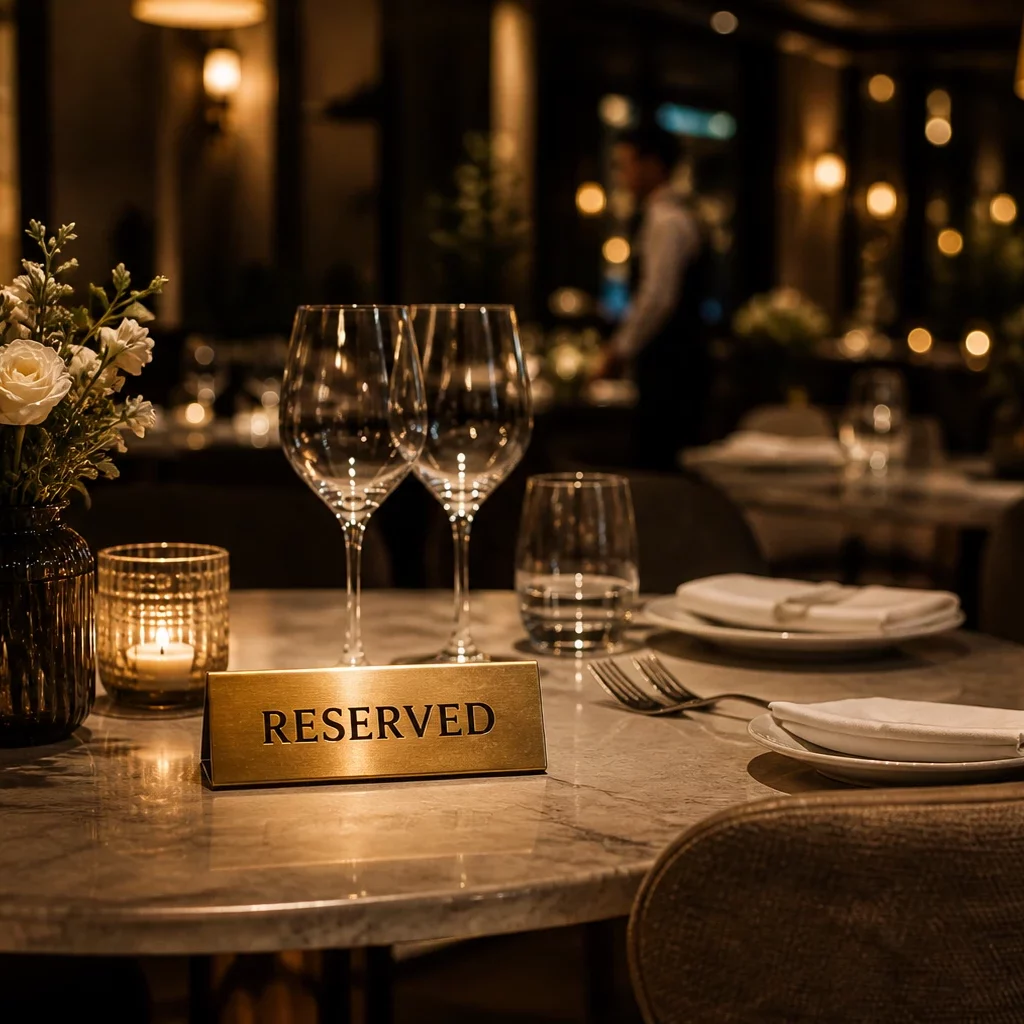
The welcome: the first 30 seconds that shape the whole meal
A guest walking through the door is looking for one thing above all: to be recognised.
The threshold is well known and unforgiving. Beyond 30 seconds with no eye contact, perception tips over. The guest no longer feels expected – they feel like an intrusion.
What the auditor watches for, precisely: the moment that first glance lands, the presence or absence of a smile, how well the table offered matches what was requested. Is the guest guided, or left to find their own way with a vague wave of the hand?
One crucial point is often underestimated. The welcome isn’t the maître d’s job alone. A server who passes an arriving guest without so much as a glance leaves a mark just as deep as a botched welcome. The welcome is collective, or it isn’t a welcome at all.
A large part of restaurant guest satisfaction plays out right here, in what the guest feels before they’ve even sat down.
Taking the order: the moment the service reveals itself
This is the most telling moment of truth for an observer.
Knowledge of the menu can’t be faked. Can the server describe a dish, name its allergens, cite its origin, suggest a pairing? Is their stance that of an advisor, or that of someone just taking notes?
Active listening shows in three signs: they repeat the order back, they confirm the cooking, they note down special requests. Conversely, a server who has to check in the kitchen for every question betrays a lack of training that the guest reads as a lack of seriousness.
This moment says everything about an establishment’s culture. A server who knows the menu is a server who has been trained, briefed, respected. A server who doesn’t is a server who was left to fend for themselves.
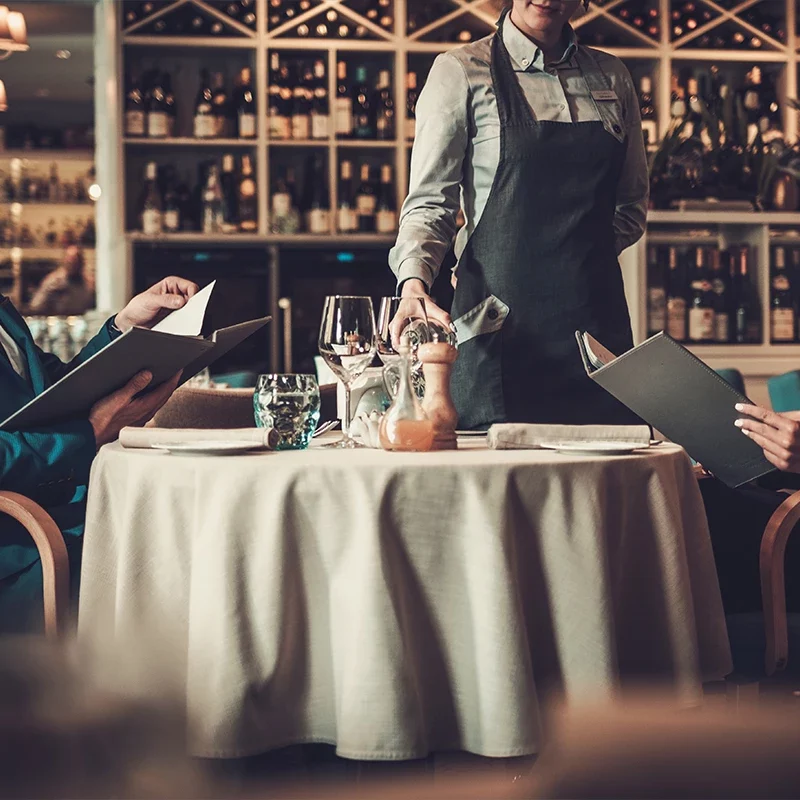
Service in the dining room: the art of pacing
Service is a score. What distinguishes a table that worked from one that was merely endured is rarely the table setting – it’s the tempo.
Three timings structure this rhythm. The time between ordering and the first items arriving. The wait between courses. The synchronisation between diners at the same table, because a dish arriving alone in front of the others creates instant awkwardness.
Then comes adapting to the type of meal. A business lunch wants speed and discretion. A family lunch tolerates slowness and warmth. A romantic dinner calls for space and quiet. The same service can’t serve three different intentions.
Availability without intrusion is an art: catching a guest’s eye at the right moment, without interrupting a conversation. Managing drinks and bread follows the same register – the kind of micro-attentions nobody notices when they’re there, and everybody notices when they’re missing.
Then there’s clearing the table. A plate taken away too soon rushes the guest. Left too long, it clutters the table and signals an overwhelmed dining room. The right tempo is a signal of mastery.
Handling the unexpected: the moment that reveals true quality
Any restaurant runs smoothly when everything goes to plan. The real test of restaurant service quality is in the gap when it doesn’t.
An order mix-up, a missing dish, incorrect cooking, an unhappy guest: what matters isn’t the incident, it’s the response.
The auditor watches for four things. How quickly the issue is addressed. The attitude – sincere or defensive. The solution offered – fitting or minimal. And the follow-up after the incident, the gesture that shows the problem wasn’t forgotten the moment the next table was seated.
The principle is counter-intuitive but well documented: a well-handled problem builds more loyalty than a meal with no hiccups at all. The guest doesn’t remember a flawless meal – they remember having been listened to.
The trap, meanwhile, is always the same: the dining room and the kitchen passing the buck. The guest hears it even when it’s not addressed to them. They conclude that an establishment looking for excuses won’t be able to stand up for them either.
The bill and the departure: the last impressions weigh the most
The end of a meal weighs more heavily on the restaurant guest experience than its middle, and the psychology of memory explains why.
The time it takes to get the bill after asking for it is a blunt indicator. Beyond 5 minutes, the experience degrades, however good it was up to that point.
Clarity of billing matters as much as the amount: consistency with the menu, promotions applied as announced, line-by-line accuracy. A muddled bill wipes out, in an instant, the trust built up over the previous hour and a half.
Then comes the manner of the send-off. Is the guest walked out? Thanked? Invited to come back? The final exchange is the one that sticks.
The peak-end rule applies here with ruthless precision: we mostly remember the most intense moment of an experience and how it ended. An excellent meal followed by a slow bill leaves a mixed memory. An imperfect service ending with a sincere gesture can, on the other hand, leave a lasting positive impression.
The detail that changes everything often comes down to a single word. A personalised line on the way out, recognising a regular, and the guest leaves thinking they’ll be back.
What an auditor’s eye changes about how these moments are read
Restaurateurs live their establishment from the inside. Over time, they stop perceiving what a guest perceives: they see their processes, their constraints, their regulars. It’s necessary – and it’s precisely what blinds them.
The auditor, by contrast, breaks down what the guest feels as a whole. They name the moments, measure the delays, identify the breakdowns. Where a review says “the service was slow,” a restaurant audit writes: “the time between ordering and the starter was 22 minutes, only at the back tables, due to a coordination breakdown between the dining room and the kitchen.”
The difference between these two sentences is the entire value of a restaurant audit: the first one observes, the second one enables action.
The restaurant mystery visit extends this same logic. It observes service under real conditions, without the teams knowing they are being assessed, and brings back what no questionnaire ever could: the hesitations, the delays, the things left unsaid.
This is the ground on which a firm like Girault-Pasqué has operated for more than ten years, in more than thirty countries, breaking down each moment of truth to make it measurable.
From moments of truth to loyalty: the real stakes
A returning guest costs less than a newly acquired one. The “five times less” figure circulates widely in the industry, though it should be handled with care: the real ratio depends on your market and your cost structure.
And above all, this guest rarely comes back for a dish. They come back because they felt expected, listened to, recognised. Restaurant guest loyalty is built in these precise instants, not in a points programme.
This is where everything comes together. The restaurant guest experience isn’t a sum of boxes ticked – it’s a succession of instants where the establishment wins or loses a guest. Every moment of truth is a decision disguised as routine.
Restaurant service quality, then, can’t be decreed in a manual. It’s played out in presence, moment by moment, and measured in the memory the guest takes away with them.
Frequently asked questions
It’s a point in the guest journey where perception of the establishment can tip, for better or worse. In a restaurant, these moments run from booking to departure, and some last only a few seconds: a glance, a delay, a word.
Six stages structure the experience: the booking, the welcome, taking the order, service in the dining room, handling the unexpected, and finally the bill and the departure. Each carries a different promise, and each can win or lose a guest.
Three approaches complement one another: guest reviews, which give the overall impression; the internal questionnaire, which captures stated intentions; and the service audit, which measures delays, gestures and breakdowns under real conditions. A restaurant’s service quality is judged on observable facts, not impressions.
A review expresses an overall feeling: “the service was slow.” A restaurant service audit breaks it down and measures it: what delay, at which tables, at what time, for what reason. The first one raises the alarm, the second one makes correction possible.
An annual assessment gives you a snapshot. Two assessments a year, spaced apart, let you track progress over time. If there’s a change of team, menu or management, an additional assessment is essential: these are the periods when service quality is most at risk of slipping.
Useful sources
- The peak-end rule, for understanding how experiences are remembered.
- Harvard Business Review, The Value of Keeping the Right Customers, on the value of a retained customer.
- Ipsos, survey on the loyalty myth and the acquisition-vs-retention cost ratio.
- UMIH, observatories and studies on the hotel and restaurant sector.
- OpinionWay for UMIH, Les restaurants vus par les Français.
- Zenchef, guide Optimiser son restaurant au quotidien.