

“`
An audit always ends with a document. A report, some notes, sometimes a presentation to management. Then Monday comes round: reception handles the arrivals, the floors get on with their rounds, the dining room lays its tables. The report gets filed away. And yet it’s in that gap, between the finding and the action, that the bulk of the guest experience is decided. Post-audit support in hospitality begins exactly there: when no one is talking about the audit anymore and everyone is simply back at work.
This article doesn’t offer another checklist. It describes what teams actually do with a report, how an auditor’s sentence turns into a service gesture, and why some management teams keep pulling that thread while others simply close the file.
What management teams expect after a mystery audit
Ask a management team what they expect from an audit, and the answer rarely fits into a single line. They want to know where to start, who’s responsible for what, and to be able to see that something has actually moved. The number of criteria, how refined the grid is, how the report is laid out – all of that matters, but it isn’t what decides the outcome.
The market, for its part, often responds with a catalogue: diagnosis, structured report, prioritised recommendations, benchmarking. That’s the core of the hotel and restaurant audits that most firms offer, and it’s valuable: an outside eye sees what familiarity makes invisible. But an audit describes a state. On its own, it doesn’t produce lasting change.
Ludovic Nodier, director of BVA Mystery Shopping, put it plainly in L’Hôtellerie Restauration: “What matters is the action plan put in place afterwards, provided staff genuinely buy into it and it’s approached as a process of improvement.” That sentence says it all: the plan, the way it’s brought to life, and the fact that teams experience it as progress rather than as a judgment.
Because a guest doesn’t remember a score. They remember a look, a word on arrival, a pillow found without having to ask for it. The experience plays out in moments, and those moments replay every single day.

Why an action plan ends up in a drawer
An unused action plan is almost never a bad plan. It’s a plan with no owner, no proof and no place in the working day.
Four things cause it to fail, in very concrete terms.
- The language. The report speaks in criteria; the service speaks in gestures. “The quality of the farewell experience is inconsistent” doesn’t tell the bellhop what to do at 11am.
- The volume. Thirty actions means thirty actions that don’t get done. A team retains what’s few in number, visible and shared.
- The lack of an owner. “Management,” “the department,” “the team” can’t be held accountable. An action with no name attached is just an intention.
- The lack of proof. Without a trace – a photo, a form, a log, an observation – no one can confirm it’s been done, and the action falls back into opinion.
There’s also a more personal reason, often left unsaid: an audit touches on pride. It describes moments when service fell short, and behind every finding is someone’s craft. Treated as a verdict, it triggers defensiveness; treated as a working basis, it can become a source of pride instead. This is also why it’s worth clarifying why to use a hotel and restaurant audit firm before launching anything: observing, improving, or settling a doubt don’t call for the same approach.
Frameworks do exist, for that matter – ISO 22483:2020, the international standard setting quality and service requirements for accommodation establishments, covers staff, cleanliness, complaints and satisfaction monitoring. But no framework applies itself: someone has to translate it, and a structure has to hold it together.
From debrief to action plan: the Girault-Pasqué method
The audit debrief is the most poorly used moment in the whole chain. And yet it’s where everything is decided.
Our approach can be summed up in one sentence: we don’t arrive with a verdict, we arrive with a reading of events. A hotel audit doesn’t say what people are worth; it says what the guest experienced, in a sequence, at precise moments. This isn’t a wording nicety – it’s what allows teams to take ownership of the subject.
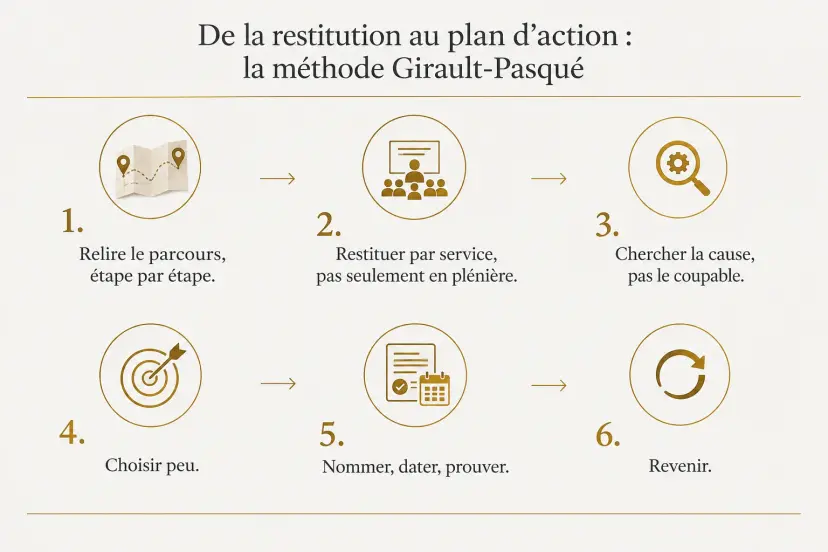
In practice, post-audit support in hospitality unfolds in a few steps, in this order.
1. Walk back through the guest journey, step by step. Booking, arrival, room, dining, departure, and everything that happens afterwards. We go back over the observations in the order the stay actually unfolded, drawing where useful on the criteria used for luxury hotel mystery shopping, to distinguish what belongs to the standard, to a gesture, or to an intention.
2. Debrief by department, not only in a plenary session. A single, solemn debrief produces nodding heads. A debrief run department by department produces reactions like “ah, so that’s what they see.” We name the situations, anonymise the people, and start with what’s working – what works needs to be shared, not just noted down.
3. Look for the cause, not the culprit. The same shortfall can stem from missing training, an unclear procedure, an unsuitable set-up, or equipment that simply isn’t up to the job. We settle this question together with the department heads, never in their place.
4. Choose few. We keep what weighs most heavily on the guest, what comes up most often, and what can be fixed fastest. The rest isn’t dismissed: it’s noted, for later.
5. Name, date, prove. Every action gets an owner, a deadline agreed with them, and an agreed form of proof. The deadline isn’t pressure – it’s what lets everyone say “it’s done” without argument.
6. Come back. We return to the same criteria, to measure movement, not to reopen a trial.
The timing of these steps is never standard. It’s set around seasonality, the property’s busy periods and the teams’ actual capacity; it’s agreed with management and known to everyone before anything begins. A modest rhythm that’s kept to beats an ambitious scheme that gets abandoned.
This sequence doesn’t stop at guest service. An audit also raises administrative, financial, marketing and communication issues, and these are often what determines whether service gestures hold up over time. This is why Girault-Pasqué offers bespoke support in implementing adjustments across the full range of issues an audit brings to light: we don’t hand over a list of recommendations for the client to sort out alone – we work with the relevant managers until the change shows up as much in the organisation as in the guest experience.
Turning a finding into operational action
A post-audit action plan hinges on a single sentence. “The welcome lacks warmth” is not an action. “On arrival, the guest is greeted by name within two minutes and offered help with their luggage” is.
The difference rests on four elements: the expected gesture, the person responsible for it, proof that it happened, and the indicator that will show its effect. An action with no proof is a wish; an action with no indicator can’t be defended in a management meeting.
| Finding | Likely cause | Expected gesture | Owner | Agreed proof |
|---|---|---|---|---|
| Special requests not passed on | Handover between booking and reception too loose | A single, written handover point, reviewed at shift start | Front office manager | Request logged in the handover book |
| Room not ready at the announced time | Poor coordination between housekeeping and reception at peak arrival times | Availability message sent before the guest arrives | Head housekeeper | Room status updated in real time |
| Guest left with no news after a complaint | Follow-up with no owner | A designated contact per complaint, with a response before the end of the stay | Accommodation manager | Complaints log and their closure |
This table does two things: it makes the report usable by the people actually doing the work, and it forces a decision. You don’t fill in the “owner” column with “the team.”
Cross-referencing with other sources changes everything. A shortfall spotted by a mystery shopper that lines up with a recurring complaint or an online review is no longer a minor detail – it’s a pattern. This is where complaint management in hospitality, often treated as mere after-sales service, becomes raw material for the action plan.
Training teams rather than correcting symptoms
A gesture that hasn’t been practised doesn’t stick. Hermann Ebbinghaus’s work on memory is a reminder of this: what’s learned fades quickly if nothing reactivates it, and what lasts is spaced, active recall – not mass repetition on the same day.
An audit often reveals a learning problem disguised as an attitude problem. The staff member who doesn’t offer to book the dinner reservation isn’t indifferent: they may simply never have known when, how, or in what words to do it. Treating the symptom – a reminder, a memo – produces an effect that lasts until the next busy period.
Training, here, doesn’t mean organising a session. It means starting from the establishment’s actual situations rather than a generic case study; having people do rather than just listen, through role-play and peer-to-peer cross-observation; revisiting the gesture at intervals, in the form of brief reminders; and handing the baton to department heads, who remain in place once the consultant has left.
The gestures in question aren’t abstract: they happen at reception, on the floors, in the dining room, in the kitchen, at the spa. Handovers, bringing a guest to their room, taking an order, answering the phone, handling an unhappy guest: this is where reputation is built, far more than in a speech from management. A well-designed mystery visit training is built for exactly this – teaching teams to recognise the moments that count, not to recite a checklist.

Follow-up: rhythm, indicators and repeat mystery visits
Post-audit follow-up for a hotel doesn’t need to be heavy. It needs to be predictable. A team that knows when the next check-in is coming, what will be looked at, and what will be done with the result, works differently.
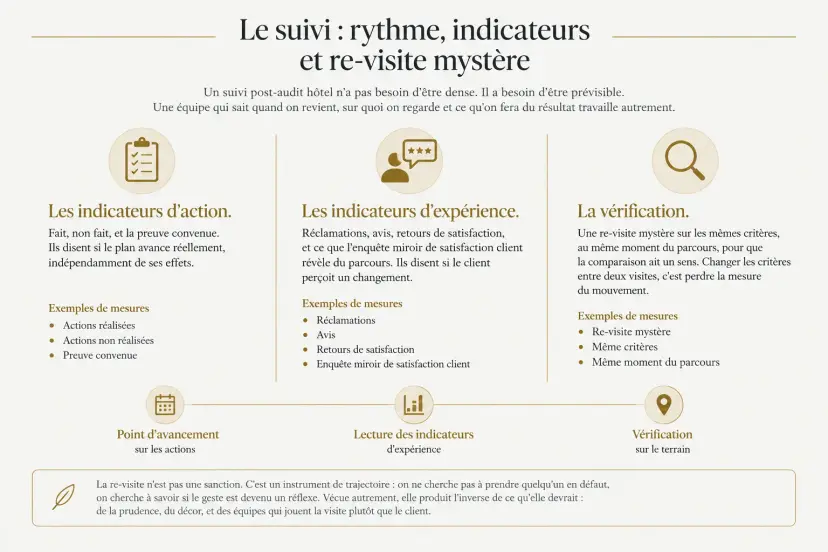
The rhythm is built together with management around three recurring moments: a progress check on the actions, a review of experience indicators, then on-the-ground verification. Neither the frequency nor the length is set in stone; what matters is that the meeting happens, that it’s short, and that it’s grounded in facts.
Three families of indicators are enough, as long as they aren’t mixed up.
- Action indicators. Done, not done, and the agreed proof. They tell you whether the plan is actually moving forward, independent of its effects.
- Experience indicators. Complaints, reviews, satisfaction feedback, and what the customer satisfaction mirror survey reveals about the guest journey. They tell you whether the guest perceives a change.
- Verification. A repeat mystery visit using the same criteria, at the same point in the journey, so the comparison actually means something. Changing the criteria between two visits loses the measure of movement.
The repeat visit isn’t a punishment. It’s a tool for tracking trajectory: the goal isn’t to catch someone out, it’s to find out whether the gesture has become a reflex. Experienced any other way, it produces the opposite of its purpose: caution, a show put on for the occasion, and teams performing for the visit rather than for the guest.
In brief
- An audit describes a state; support builds a trajectory. The report isn’t the end point – it’s the starting point.
- Post-audit support in hospitality isn’t limited to guest service: Girault-Pasqué provides bespoke support in implementing the operational, administrative, financial, marketing and communication adjustments an audit brings to light.
- A post-audit action plan rarely fails for lack of content, but for lack of an owner, proof, and a place in the real working day.
- A department-by-department debrief, in the language of the trade, turns a finding into a shared topic; a single plenary session mostly produces nodding heads.
- An action is defined by an expected gesture, a named owner, agreed proof and an indicator. Without these four elements, it’s just an intention.
- Training addresses the cause; correcting symptoms only addresses the report.
- Post-audit follow-up for a hotel rests on a predictable rhythm and three families of indicators: action, experience, verification.
- A repeat mystery visit measures movement; experienced as a punishment, it produces a performance instead.
An audit doesn’t transform a property. It’s the gestures it makes possible, repeated by teams who believe in them, that do – and that’s not something a report can decide on its own.
Sources
- “Clients mystère : un outil d’amélioration continue,” Violaine Brissart, L’Hôtellerie Restauration, 22 August 2019 – lhotellerie-restauration.fr
- “Premier établissement d’hébergement en Italie certifié ISO 22483:2020,” AFNOR International, 20 October 2025 – international.afnor.com
- “Courbe de l’oubli,” summary of Hermann Ebbinghaus’s work (1885), Wikipedia – fr.wikipedia.org, accessed 5 November 2026
“`